Hillary Clinton refers to Henry Kissinger’s World Order as “vintage Kissinger.” While she undoubtedly intends the phrase as fulsome praise, it makes me far less excited about reading Kissinger’s earlier works. Kissinger’s writing is both dense and assumes a high level of background knowledge on global political history. If you have the adequate context to understand his work, it feels brilliant and packed with insight. Otherwise, it may feel like a vaguely related history survey smattering. I’ll readily admit that the fault is largely mine – I’m not well equipped to read and understand Kissinger on the first go. The impressive list of contemporary political greats that festoon the back cover of his book clearly shows Kissinger’s intended audience.
Word Order begins by discussing in brief the historical development of regional world orders in post-Westphalian Europe, the Islamic Middle East, and the ungeneralizable Asian landscape. Kissinger introduces the United States’s more recent contributions to shaping world order and uses a US-centric lense to opine on global developments during his contemporary career. This is not a book report so allow me the liberty of summarizing: regional world orders are different for complicated, nuanced reasons and its important to understand how and why they’re different.
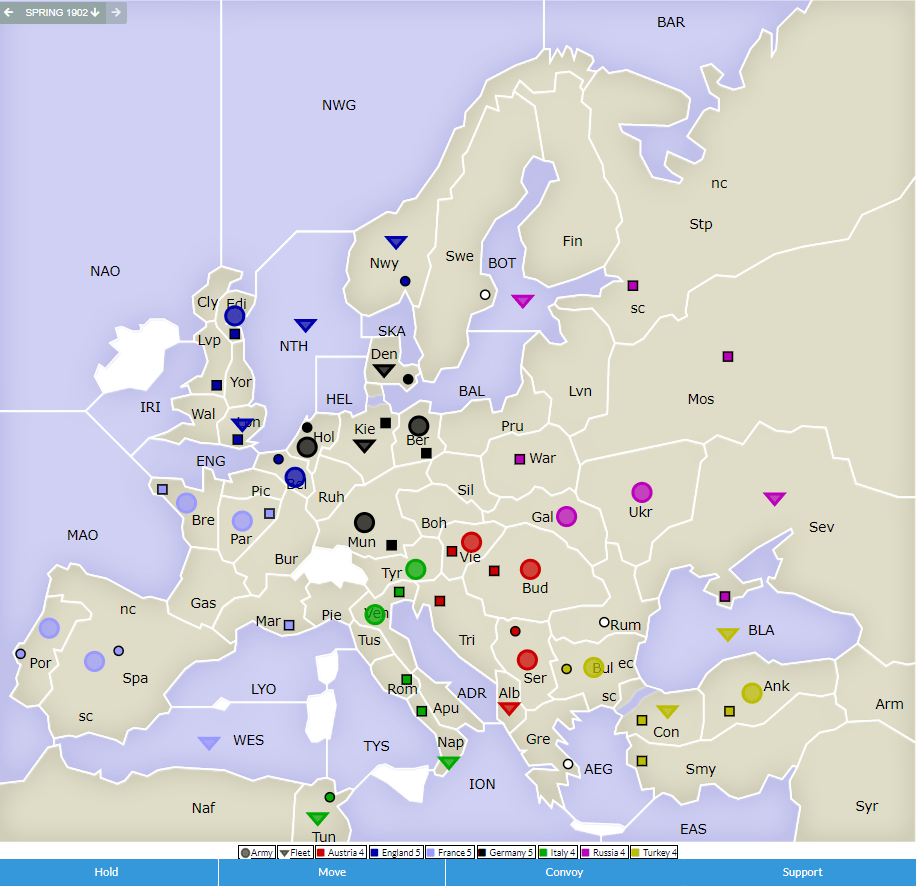
As I was finishing up World Order, I started my first game of Diplomacy. Diplomacy is a negotiation focused board wargame based on a historically accurate 1914 Europe. Delightfully, in writing this post, I’ve also learned that Kissinger was a major fan of this board game. World Order characterizes the beginnings of WWI as the end of the fluid and pragmatic Westphalian order. The unification of Germany in response to an adversarial France destroyed the critical flexibility in the Westphalian system and brought about WWI. Playing Diplomacy is a condensed history lesson in the complicated network of alliances leading up to WWI. Players negotiate fluid alliances with the expectation of betraying and being betrayed. Optimal play is based on predicting and counter-predicting your opponents’ intentions. The game is high-commitment yet incredibly rewarding – a great exercise to practice your social engineering as well as familiarize yourself with the political geography of 1914 Europe. While the alliances are too Westphalian to be historically accurate, the games ends when a dominant alliance is able to subsume its opponents and impose a new world order (no wonder Kissinger loved this game).
Some initial Diplomacy impressions:
- Avoid playing Germany your first game. Unless you are Otto von Bismarck reincarnated, Germany’s necessary hyperactive negotiation makes it difficult for noobs.
- Regardless of your country, study some proper opening strategy – the internet is resplendent with Diplomacy guides. You will look and feel far less like a noob in your initial negotiations.
- Making alliances on the basis of who is most friendly and responsive to you in chat is a recipe for getting betrayed.
- The aptly named backstabbr platform is a great place to play online correspondence Diplomacy with your friends.
 Erick's Blog