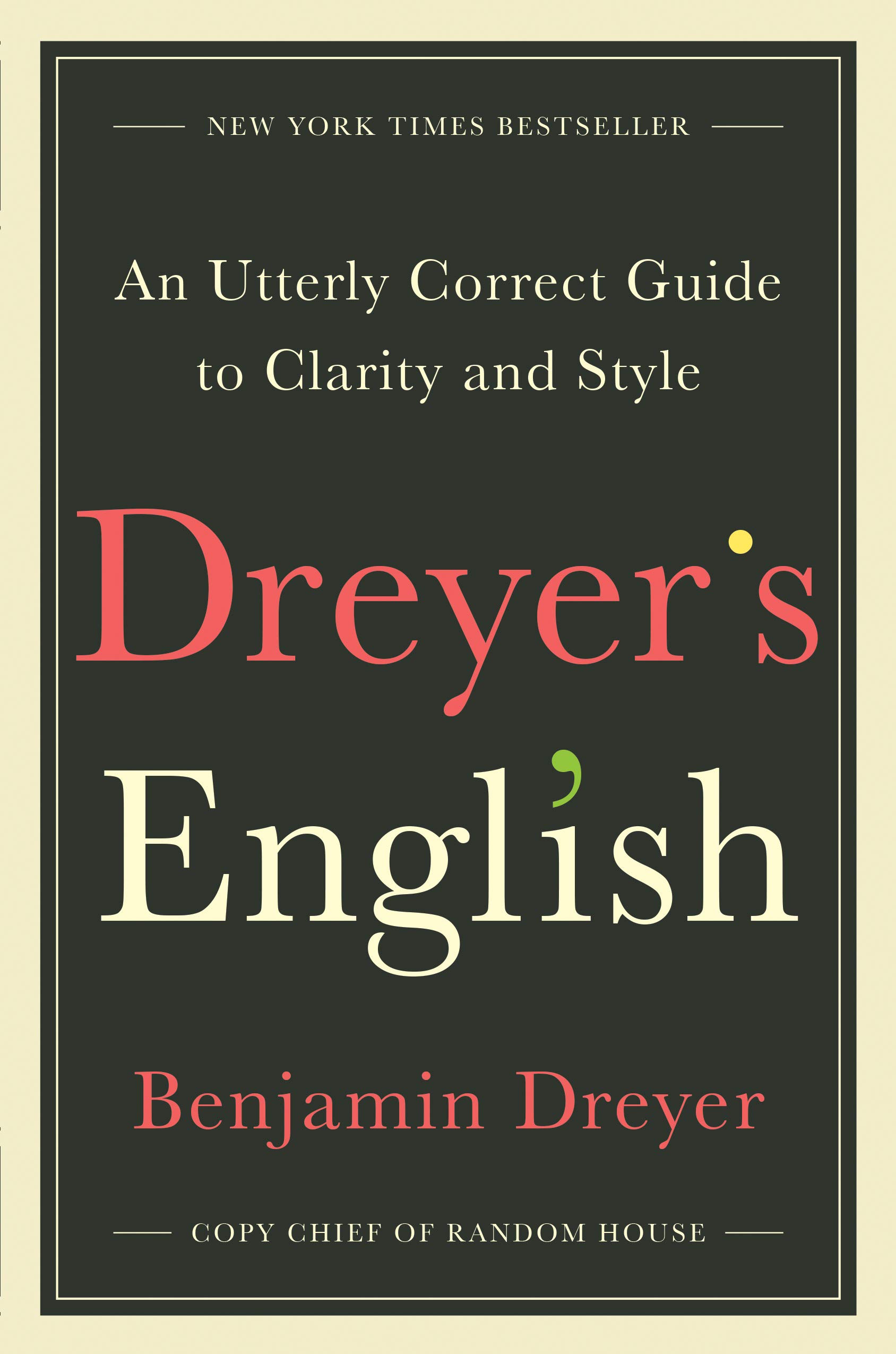
Today I pulled out from storage Dreyer’s English – An Utterly Correct Guide to Clarity and Style by Benjamin Dreyer. As an aside, pro strat for the day: when storing books in giant moving boxes, stack them so their spines are readable. It will make retrieval so much easier. I learned this the hard way.
In his book, Dreyer condenses a career’s worth of copy editor experience into well organized sections and rule lists. He speaks cleverly yet authoritatively – abiding by his book feels like Dreyer himself is editing your work. Clever anecdotes and annotations fill the margins, bringing life and Dreyer’s dry wit to an otherwise dry topic. When I last attempted to read the book cover to cover, I made it just half way, or as Dreyer calls “the stuff in the front.” For a writing tyro like me, a rulebook is too abstruse and inaccessible for me to internalize. However, it’s delusionally narcissistic to think my readers will come just for the brilliance of my thoughts, bravely overcoming poor writing and tasteless style. I’ll reserve that for my personal journal, which hopefully none of you have the misfortune of reading. I’m being only semi-facetious here – I believe in a marked and warranted carefulness when writing thoughts for others.
Dreyer starts with a “tidying up” challenge, eschewing the use of certain filler words. According to Dreyer, these words significantly weaken our writing despite being natural in our speech. I feel an intimate familiarity with these words – they pepper my speech and fill my journal. Here are Dreyer’s challenge words and their incidence in the current 7k words of my public blog:
- very (1)
- rather (0)
- really (1)
- quite (1)
- in fact (0)
- just (merely) (6)
- so (extremely) (4)
- pretty (1)
- of course (0)
- surely (0)
- that said (0)
- actually (0)
I’ll admit that these counts are lower than expected. There’s some self-congratulation here combined with chagrin as I realize the usage occurs primarily in my recent posts. Clearly, my writing is experiencing a tradeoff between output volume and edit quality. Dreyer Chapter 1 is easy to understand and internalize. The rest of Dreyer reads like a reference material with colorful footnotes. As I become more cognizant of stylistically off-putting element of my writing, I’ll become more familiar with Dreyer. For example, I’ve been increasing the usage of dashes – am I using them correctly? I look up “dash” in Dreyer’s index and read the corresponding sections. Apparently, em dashes are distinct from en dashes (characterized by the length of the dash). Em dashes are used for either 1) interruption of dialogue or 2) parenthetical asides without the parentheses. Unfortunately, this is all for naught because the WordPress text editor renders everything as em dashes.
 Erick's Blog